Yard To Table
A production-minded full-stack platform for a pre-launch lawn-care and garden-planning business, combining public lead intake with a foundation for property and service operations.
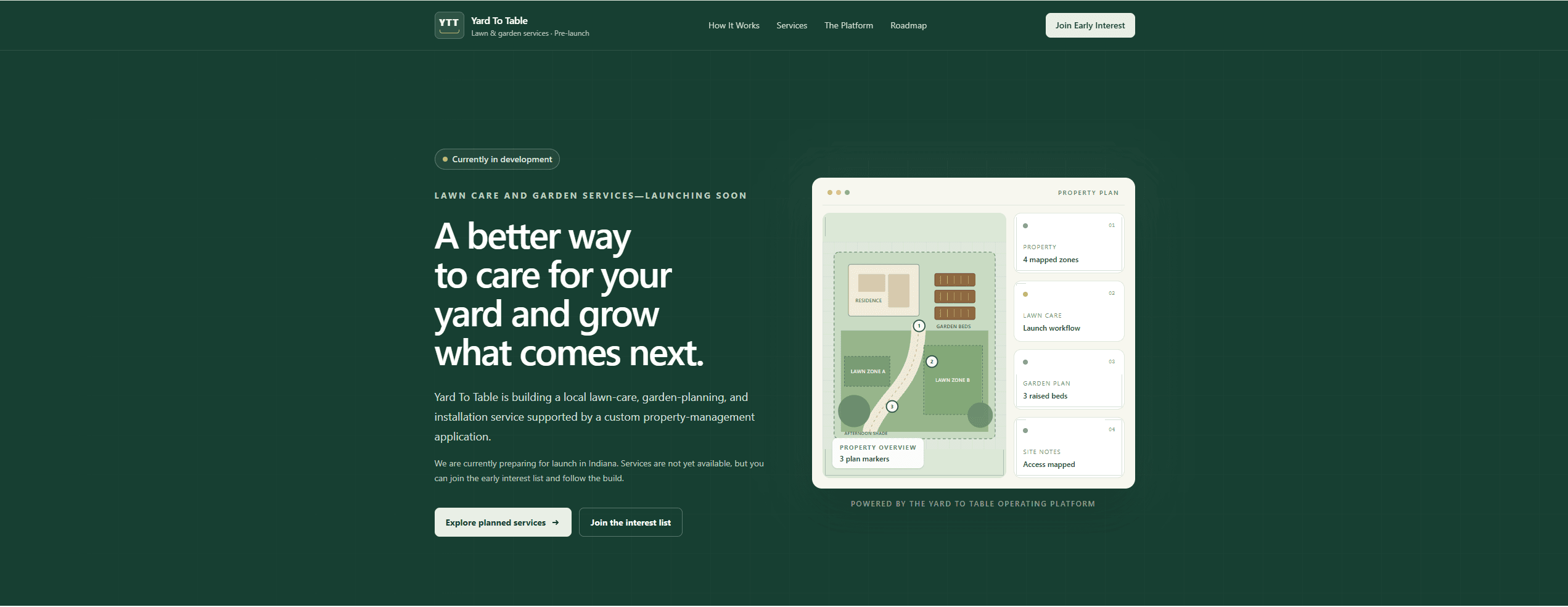
Project context
Yard To Table is a full-stack application being developed alongside a future lawn-care, garden-planning, and installation business. The business is still pre-launch. Its public experience introduces the planned services and collects early customer interest through a working lead-intake flow. The underlying application is designed to eventually manage the operational journey from property records and assessments through estimates, scheduling, jobs, and ongoing care; those broader workflows remain on the roadmap. The project also serves as a software engineering portfolio case study, with future multi-company SaaS potential treated as an architectural direction rather than a currently implemented product.
The challenge
- Balancing three goals: a credible future service business, a technically strong portfolio project, and a foundation that could later support a SaaS product.
- Keeping development and production data isolated while maintaining a straightforward Prisma migration workflow.
- Modeling services around real business rules instead of treating every operational task as a separate customer-selectable service.
- Presenting unfinished business and software capabilities honestly without making the application feel like a placeholder.
My contribution
- Designed and developed Yard To Table from an initial business concept into a deployed full-stack application.
- Built a responsive public lead-intake workflow with shared Zod validation, typed GraphQL operations, resolver and service-layer separation, and Prisma persistence to Neon Postgres.
- Integrated Resend for server-side lead notifications while preserving a successful lead submission when notification delivery fails after the database write.
- Created separate development and production database environments using Neon branches and environment-specific deployment configuration.
- Redesigned the public experience around a pre-launch lawn-care and garden-planning business powered by custom operational software.
- Modeled the launch lawn-care service around real business rules, bundling mowing, trimming and edging, and cleanup into one customer-selectable offering.
- Established a foundation for future property, assessment, estimate, scheduling, job, and ongoing-care workflows without prematurely implementing multi-tenancy or subscriptions.
Technical approach
- The implemented lead flow collects first and last names, Indiana service details, and the currently enabled bundled lawn-care interest through responsive loading, success, and error states.
- Shared Zod rules validate inputs on both client and server before a typed createLead GraphQL mutation reaches the resolver and service layers.
- Prisma persists leads to Neon Postgres before Resend sends the server-side notification, with failures handled according to whether the database write succeeded.
- Authentication, administrative lead management, property assessments, estimates, scheduling, jobs, payments, reporting, and SaaS multi-tenancy remain roadmap items.
- Next.js
- React
- TypeScript
- GraphQL
- Apollo Client
- Apollo Server
- Prisma
- Neon Postgres
- Zod
- Resend
- Vercel
- GitHub Actions
Solutions
- Positioned Yard To Table as a pre-launch service company powered by a custom operational platform.
- Used separate Neon branches and environment-specific database configuration for development and production.
- Implemented a layered lead-submission architecture with shared validation, GraphQL, a service layer, Prisma, and Resend.
- Kept future SaaS concerns in mind without adding speculative organization, billing, or multi-tenant complexity too early.
Outcomes
- Deployed a working public application to Vercel.
- Completed the first end-to-end vertical feature from public form submission through database persistence and email notification.
- Established an extensible architecture and roadmap for future operational workflows.
- Created a project demonstrating product design, frontend development, backend integration, database modeling, validation, deployment, and CI/CD practices.
Have a product or workflow that needs a thoughtful interface?